Searching for Bluetooth speakers for business is a sensible place to start. They are cheap, familiar, and you can set one up in seconds. For a café, shop, gym, or office in India, though, a portable Bluetooth speaker hits its limits fast. This guide compares Bluetooth speakers and distributed audio for a business, honestly, and shows how to keep the convenience of Bluetooth without the drawbacks.
Why Businesses Reach for Bluetooth Speakers
The appeal is easy to understand. A Bluetooth speaker costs little, needs no installation, and everyone already knows how to use one. For a tiny stall, a pop-up, or a single small room, that can genuinely be enough.
The trouble starts when the business grows beyond one corner. A speaker designed to sit on a table for a picnic is being asked to run a venue all day, and that is not the job it was built for.
Where Bluetooth Speakers Fall Short in a Business
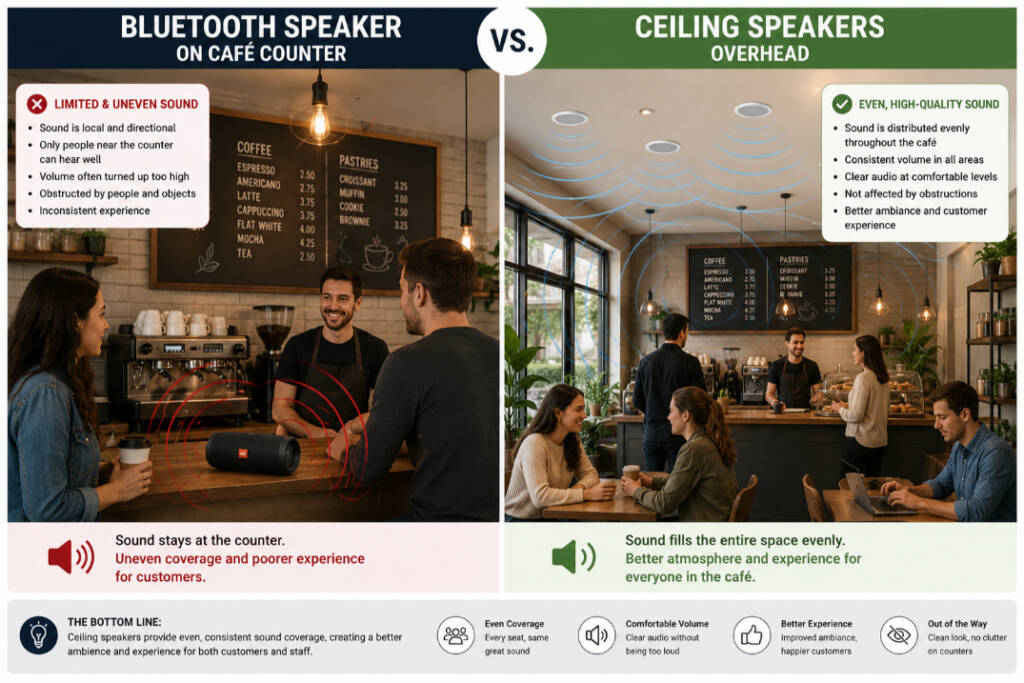
The problems show up quickly. A single speaker is loud right next to it and faint across the room, so coverage is uneven. It only covers one area, so a shop floor and a back room cannot share even sound. Pairing drops, range is limited, and the phone that streams the music is tied up and interrupted by every notification and call.
There is also the daily grind. Portable speakers are not built to run from open to close, every day, and a flat battery means silence. They offer no microphone for announcements, no separate zones, and no way to fill a whole space evenly. For a real business, those gaps add up.
What Distributed Audio Is
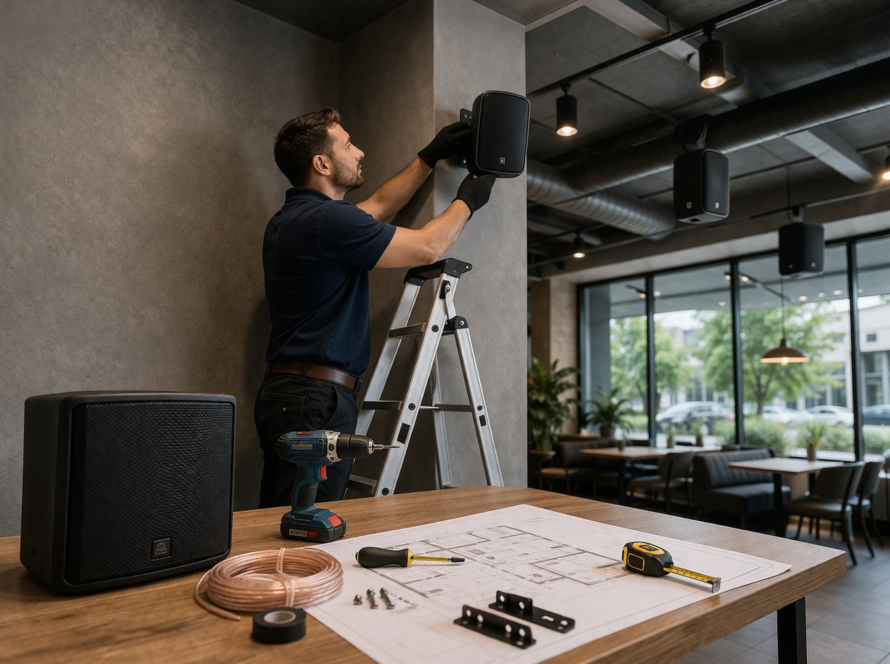
Distributed audio is the commercial alternative. It uses several fixed speakers, in the ceiling, on walls, or outdoors, all wired to one amplifier, usually on a 100V line. As Biamp explains, this constant-voltage approach lets many speakers run from a single amplifier over long cable runs, which is why it is the standard for music and paging across a whole building. The result is even sound everywhere, not one loud corner.
Distributed Audio vs Bluetooth: The Comparison
| Factor | Bluetooth speaker | Distributed audio |
|---|---|---|
| Coverage | One spot, uneven | Even across the whole space |
| Area and zones | One room only | Whole venue, multiple zones |
| Reliability | Pairing drops, battery limits | Wired, runs all day |
| Music source | Phone tied up, interruptions | Dedicated input, plus mic paging |
| Look | A box on the counter | Discreet, fixed, out of the way |
| Best for | A stall or pop-up | Any real venue |
You Don’t Have to Give Up Bluetooth
Here is the part most comparisons miss. What people really want from Bluetooth is the easy streaming from a phone, not the speaker itself. You can have exactly that in a proper system.
Many commercial amplifiers include a Bluetooth input. The Winston RC 40 and MX 240 both let you stream from a phone just as you would to a Bluetooth speaker, except the music then plays through every speaker in the building. You get the convenience of Bluetooth and the even, reliable, venue-wide sound of distributed audio at the same time.
Which Should Your Business Choose?
The honest answer depends on scale. A tiny stall, a pop-up, or one very small room used occasionally can do fine with a good Bluetooth speaker. But any real venue with more than one area, all-day trading, or a need for announcements is better served by distributed audio. A high-street shop, a multi-room restaurant, a gym, or a hotel all fall firmly in that second group.
You can plan the whole thing as one background sound system, and ask for a layout and quote for your space.
Frequently Asked Questions
Can you run a business on Bluetooth speakers?
For a tiny stall or a single small room, a Bluetooth speaker can be enough. For most businesses it is not. A portable speaker covers only one spot, ties up a phone, and is not built for all-day use. A café, shop, or gym needs even sound across the whole space, which a single Bluetooth speaker cannot provide.
What is distributed audio?
Distributed audio is a system of several fixed speakers wired to one amplifier, usually on a 100V line. The speakers are spread across the ceiling, walls, or outdoor areas to give even sound everywhere. It is the standard way to play music and announcements across a whole business.
Why do shops and restaurants use installed speakers instead of Bluetooth?
Installed speakers give even coverage across the whole venue, run reliably all day, and can be split into zones with their own volume. They also free up the phone and allow microphone paging. A single Bluetooth speaker cannot match that, which is why most shops and restaurants use a fixed system.
Can I still stream music from my phone with a commercial sound system?
Yes. Many commercial amplifiers, such as the Winston RC 40 and MX 240, include Bluetooth input. You stream from your phone exactly as you would to a Bluetooth speaker, but the music plays through the whole distributed system. You get the convenience of Bluetooth with even, venue-wide sound.
How many zones can Bluetooth speakers cover?
A Bluetooth speaker covers one zone, the area around it. To play different music or set different volumes in separate areas, you need a distributed system with a multi-zone amplifier. That lets a café play one thing inside and another on the terrace, which Bluetooth speakers cannot do.