How many speakers do you need? The honest answer is that it depends on even coverage, not on loudness. Get the commercial speaker spacing right and sound is smooth and comfortable everywhere. Get it wrong and you fight loud spots near the speakers and dead corners far from them, while staff keep nudging the volume. This guide gives you a simple method to work it out for any commercial space in India, whatever speaker type you use.
Start With Even Coverage, Not Loudness
The biggest mistake is buying a few powerful speakers and turning them up. That makes the area near each speaker too loud and the far corners too quiet. The fix is more speakers, each running at a lower level, so the sound blankets the room evenly.
This is the whole idea behind commercial sound design. You are not trying to fill a room from one corner. You are spreading many gentle sources so that wherever someone stands, the music or announcement sounds the same.
The Square-Footage Starting Point
For ceiling speakers playing background music, a good rule of thumb is one speaker per 200 to 250 square feet of floor. So a 1,000 square foot café needs roughly four to five ceiling speakers, and a larger floor needs proportionally more. This is your starting estimate, which you then adjust for height, loudness, and speaker type.
Ceiling Height Changes Commercial Speaker Spacing
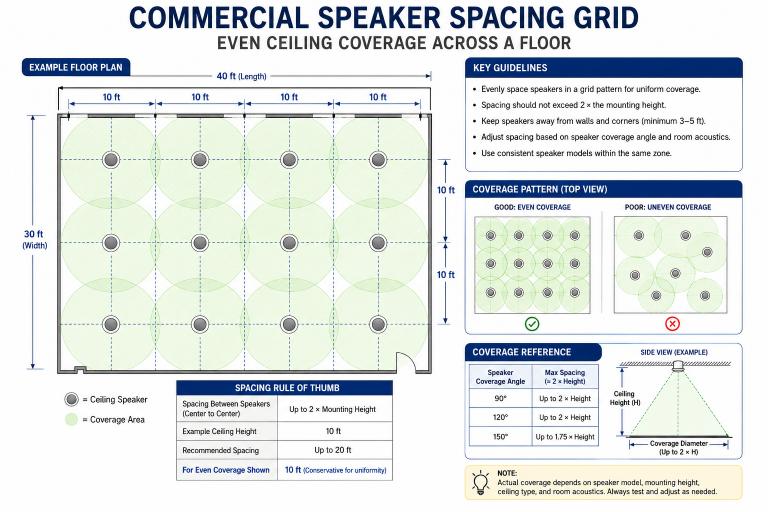
Ceiling height is the factor people forget, and it changes the spacing directly. A speaker on a high ceiling spreads its sound over a wider circle on the floor, so the speakers can sit further apart. The trade-off is that the sound has further to travel, so the level reaching people drops and you may need more power.
A low ceiling is the opposite. Each speaker covers a smaller circle, so you space them closer together to avoid loud patches directly below each one. For smooth background sound, position speakers so their coverage circles just overlap, leaving no gaps in between.
Match the Layout to the Speaker Type
The right number also depends on how the speakers mount, so plan the layout around the type. Ceiling speakers go in an even grid for overhead coverage, which suits offices, cafés, and shops. Wall speakers are directional, so you space fewer of them along the walls and aim them at the seating or floor area, which works well in gyms and halls. Outdoor speakers need to sit a little closer together, because sound disperses faster in open air with no walls or ceiling to contain it. Pendant speakers hang down in high or open spaces to bring the sound to a useful height.
A flush ceiling model like the Spectre CI 6 suits the grid approach, while a wall speaker like the Jaguar Series suits aimed, directional coverage.
More Speakers for Music, Fewer for Speech
What the system is for changes the count too. Even background music needs closely spaced speakers so the sound is smooth as people move around. A system used mainly for announcements and paging can use fewer, more widely spaced speakers, because clarity matters more than seamless musical fill. Louder areas, such as a gym floor, need more power per speaker rather than simply more speakers.
Spacing for Large and Open Spaces
Big halls and open areas are where the distributed approach really pays off. Many smaller speakers at a low level beat a few loud ones, because the sound stays even and the room echoes less. In a large, hard-surfaced hall, too much reverberation blurs both speech and music, so spreading the sound thin and even keeps it clear. Wire the many speakers on a 100V line so they all run from a single amplifier.
A Quick Worked Example
Picture a 1,000 square foot restaurant in Mumbai with a 3 metre ceiling. Start with the rule of thumb, which gives four to five ceiling speakers. The ceiling is a normal height, so a standard grid works, spaced so each speaker’s coverage just overlaps the next. Add an outdoor pair for the terrace, run the whole thing on a 100V line, and you have even sound across the venue from one amplifier. A larger banquet hall would simply scale the same method up.
Get Your Layout Right
The method gets you a confident estimate, and the final layout depends on the exact room. Plan the speakers, the background sound system amplifier, and the zones together, then ask for a layout and quote matched to your space.
Frequently Asked Questions
How do I calculate the number of speakers for a commercial space?
Start with the floor area and the kind of coverage you want. For background music from ceiling speakers, plan for roughly one speaker per 200 to 250 square feet. Then adjust for ceiling height, how loud the space needs to be, and the speaker type. The goal is even sound everywhere, not maximum volume from a few units.
How far apart should commercial speakers be?
Spacing follows ceiling height. As a rough guide, the higher the ceiling, the further apart ceiling speakers can sit, because each one covers a wider circle on the floor. For even background sound, position speakers so their coverage areas just overlap, leaving no gaps between them.
Does ceiling height change how many speakers I need?
Yes. A higher ceiling spreads each speaker’s sound over a wider area, so you can space them further apart, but the level reaching people drops, so you may need more power. A lower ceiling needs speakers closer together to avoid loud spots directly below each one.
How many speakers do I need for a large open space?
Large, open, or echoey spaces sound best with many smaller speakers at a low level rather than a few loud ones. This spreads sound evenly and reduces echo. Wire the many speakers on a 100V line so they can all run from one amplifier.
Do I need more speakers for music than for announcements?
Usually, yes. Even background music needs closely spaced speakers so the sound is smooth everywhere. Speech-only paging can use fewer, more spread-out speakers, since clarity matters more than even musical fill. Louder areas like a gym also need more power per speaker.