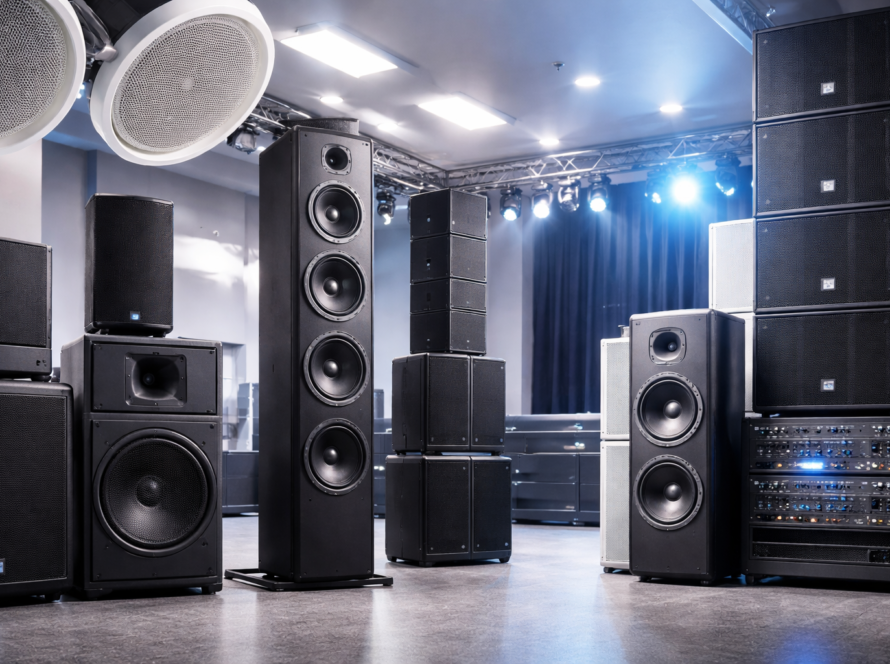
The wall vs ceiling speakers question comes up in almost every commercial install, and the answer shapes your coverage, your look, and your budget. But there are two more options people forget: pendant and column. Pick the wrong mounting and you fight dead spots, awkward sightlines, and extra cost forever. This guide explains when to use each type, so your space sounds even and looks right.
Wall vs Ceiling Speakers: The Core Choice
Most installs come down to this one decision first. Ceiling speakers sit flush overhead and spread sound evenly down across a whole room. They are discreet and ideal for background music in offices, cafés, retail floors, and dining areas. They do need a ceiling void to sit in.
Wall-mounted speakers face out from the wall and throw sound directionally into a space. They suit rooms with no ceiling void, hard concrete ceilings, or areas where you want sound aimed at a zone. The quick rule: for even background coverage, choose ceiling; for directional sound or where you cannot open the ceiling, choose wall.
When Wall-Mounted Speakers Win
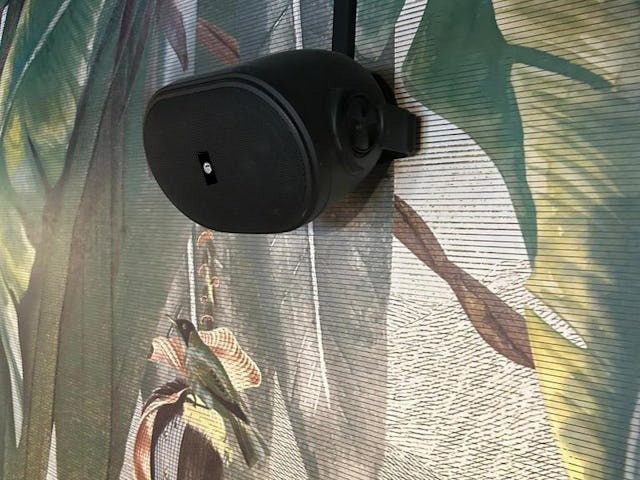
Wall speakers solve real problems that ceiling speakers cannot. Choose them when the ceiling is solid concrete, a heritage finish, or simply has no void to mount into. Choose them when you want directional coverage, such as sound aimed across a gym weights floor or down a long hall. They are also the easiest retrofit, since you avoid cutting into ceilings.
Winston Acoustics covers this with the Jaguar Series, a wall speaker with a 5-inch woofer, IP56 rating, selectable 8-ohm, 70V, or 100V operation, 90 dB sensitivity, and up to 80W. For compact, aimed sound in tighter spots, the Mini Cube swivel speaker mounts on a bracket and points exactly where you need it.
When Ceiling Speakers Win
Ceiling speakers are the default for even, invisible background sound. In an office, café, shop, or restaurant with a standard ceiling, they give the cleanest result with the least visual clutter. A flush model like the Spectre CI 6 blends into the ceiling while covering the room evenly. If your ceiling is normal height and you want background music people feel rather than see, ceiling wins.
When to Hang Pendant Speakers
Pendant speakers solve the high-ceiling problem. In warehouses, double-height lobbies, exposed-ceiling restaurants, and industrial-style cafés, a flush ceiling speaker would sit too far above people, and the sound would scatter before it reached them.
A pendant speaker hangs down on a cable to a useful listening height, so sound arrives clear and even. The Winston Rhine pendant suits these spaces, and being weatherproof, it also works under open or semi-covered roofs. Where the ceiling is high or open, pendant beats both wall and flush ceiling.

What About Column Speakers?
Column speakers are tall, narrow speakers that project speech over distance and tightly control how sound spreads up and down. That makes them a favourite for large, echoey, speech-critical rooms like churches, auditoriums, and big assembly halls, where intelligibility matters most. In those rooms, excess reverberation blurs speech, and a column’s narrow vertical spread helps keep words clear.
Here is the honest part. Winston Acoustics’ range centres on ceiling, wall, pendant, and outdoor speakers rather than column line arrays. For most commercial music and announcement needs, a well-planned layout of wall or ceiling speakers does the job cleanly. For a very large, speech-first hall, either a specialist column array or a dense distributed layout of wall and ceiling speakers are the routes to consider.
Most Installs Mix Mounting Types
Real venues rarely pick just one. A hotel might use ceiling speakers in the dining room, wall speakers along a corridor, pendant speakers under a high atrium, and outdoor speakers on the terrace. The trick is to plan each area as its own zone and feed them all from a multi-zone amplifier, so every space runs at its own level. You can build this from one background sound system rather than juggling separate setups.
Quick Decision Guide
Keep it simple. For even background sound under a normal ceiling, use ceiling speakers. For directional sound or where you cannot open the ceiling, use wall speakers. For high or open ceilings, hang pendant speakers. For a large, speech-critical hall, look at a column array or a dense distributed layout. When in doubt, ask for a layout and quote.
Frequently Asked Questions
Wall or ceiling speakers — which is better?
Neither is universally better; it depends on the room. Ceiling speakers give even, discreet background coverage across a whole room, ideal for offices, cafés, and retail. Wall-mounted speakers throw directional sound at a specific area and suit gyms, halls, or rooms with no ceiling void. Many installs use both.
When should you use pendant speakers?
Use pendant speakers when the ceiling is high, open, or exposed, such as in warehouses, double-height lobbies, or industrial-style cafés. Hanging the speaker brings it down to a useful height so sound reaches people instead of getting lost above them. The Winston Rhine pendant suits these spaces.
What are column speakers used for?
Column speakers are tall, narrow speakers that project speech over distance and control how sound spreads vertically. They suit large, reverberant, speech-critical rooms like churches, auditoriums, and big halls. For most commercial music and announcement needs, well-placed wall, ceiling, or pendant speakers are simpler and just as effective.
Can you mix wall and ceiling speakers in one system?
Yes, and most real installations do. You might use ceiling speakers in the dining area, wall speakers on the gym floor, and pendant speakers under a high atrium. A multi-zone amplifier ties them together and lets each area run at its own level.
What wall-mounted speakers are best for a restaurant or gym?
Choose directional, durable wall speakers that handle long hours. The Winston Acoustics Jaguar Series suits gym floors and restaurant walls, with a 5-inch woofer, IP56 rating, selectable 8-ohm, 70V or 100V operation, and up to 80W. Aim them down at the area you want to cover.