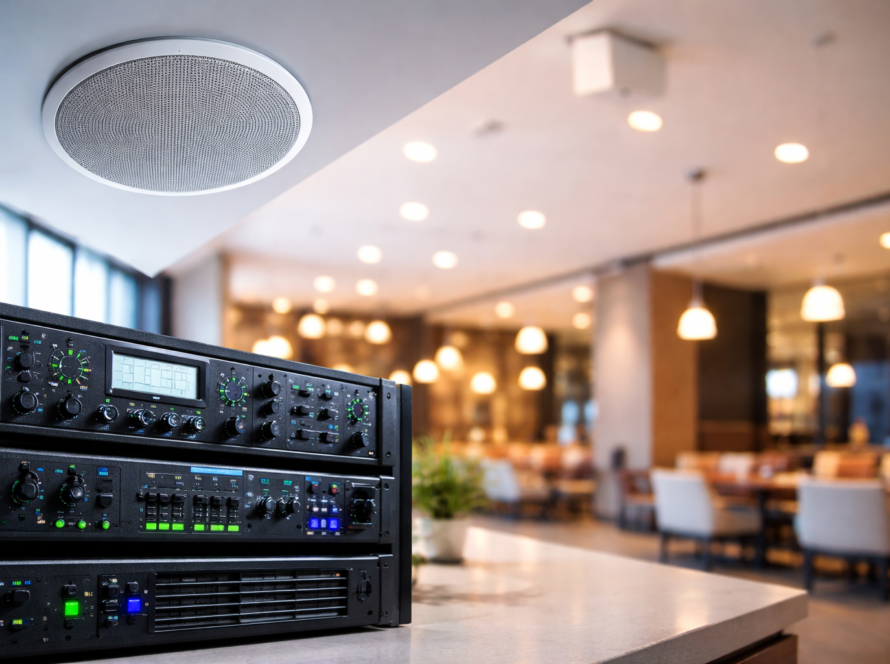
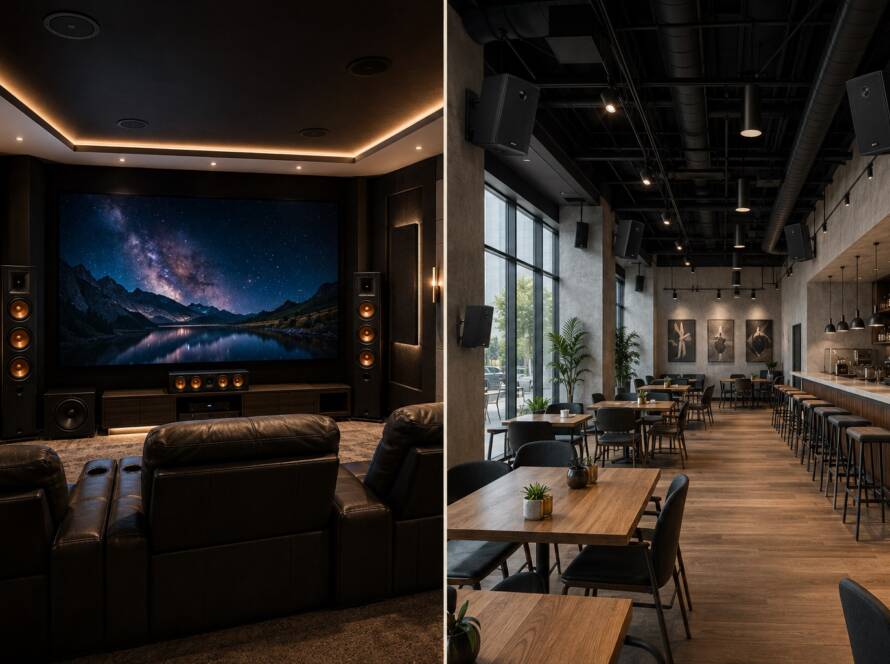
A banquet hall sound system has to do several jobs at once. It must carry clear speeches, warm dinner music, and energetic dance-floor sound, often in one large, echoey room. Most halls get by on a hired DJ rig and a couple of harsh speakers, then struggle the moment a host picks up a microphone for a toast. This guide shows hall owners how to plan an installed system that handles every kind of function, from a wedding to a corporate conference.
What a Banquet Hall Sound System Must Handle
Start with the events, not the gear. A single hall hosts weddings, receptions, sangeets, corporate meetings, conferences, and parties. Each one leans on sound differently.
Three jobs come up again and again. Speech has to be clear, so every guest follows the anchor, the speeches, and the vows. Dinner music needs to sit warm and low under conversation. Dance and DJ sets need real energy without turning to mush. On top of all that, staff need to make announcements.
A large hall makes this harder. High ceilings and hard floors create echo that smears speech. So even coverage and careful speaker placement matter as much as raw power.
Plan Your Banquet Hall in Zones
Map the hall before choosing speakers. Most venues break into clear zones: the entrance and foyer, the main hall, the stage or dais, the dining area, the dance floor, and any outdoor lawn or garden.
Each zone wants its own level and often its own source. A multi-zone amplifier such as the Winston MX 240 makes this simple, with independent volume per zone and microphone inputs for speeches. The stage can carry a speech while the dining area stays soft and the foyer plays a gentle welcome. For coverage, plan roughly one speaker per 200 to 250 square feet, and tighten the spacing under high ceilings.
Choose Speakers for Each Zone
Match the speaker to the job in each area.
For dining and general ambience, use full-range speakers like the Odin Series. They deliver warm, detailed music with clear vocals, and keep headroom to lift the level as the evening builds.
For the main hall and dance floor, use higher-output speakers. The Jaguar Series wall speaker handles directional, high-SPL zones, with a 5-inch woofer, IP56 rating, selectable 8-ohm, 70V, or 100V operation, and up to 80W. For very large halls that need real punch, the Ares delivers 500W RMS, a 15-inch driver, and up to 123 dB SPL.
For foyers and pre-function ceilings, the Spectre CI 6 gives discreet, even coverage. For high or open ceilings, pendant speakers drop the sound closer to guests. For an outdoor lawn or garden, weatherproof IP65 speakers like the Royale and Aston Series handle sun, dust, and rain as a separate zone.
Speeches and Announcements Come First
A wedding or event lives or dies on whether guests can hear the speeches. That makes the microphone chain as important as the music.
Use a wireless microphone fed through an amplifier with a mic input, like the MX 240, that ducks the music automatically while someone speaks. Place speakers so they do not point back into the open mic, which prevents feedback. Get this right and every toast, vow, and announcement lands cleanly.
Mind the Volume and the Law
Functions get loud, so plan for it. The World Health Organization recommends a maximum average of 100 dB for venues and events. Keep the dance floor energetic, but protect guests and staff who are there all night.
Outdoor and late functions also carry legal limits in India. Under the Noise Pollution (Regulation and Control) Rules, 2000, loudspeakers need permission from the local authority, and night-time use between 10 PM and 6 AM is restricted, with only limited festive exceptions. Plan lawn and rooftop audio with controlled coverage and sensible levels. This is general information, not legal advice, so confirm the current local rules before a big event.
Installed System vs Hiring a DJ Rig Each Time
Many halls lean entirely on the visiting DJ’s speakers. That works for the dance set, but it leaves speeches thin, dinner music harsh, and announcements unreliable, and the sound changes with every vendor.
An installed banquet hall sound system fixes this. It delivers consistent speech, background music, and paging for every function, while the DJ simply plugs into it for the dance set. Over dozens of events a year, that reliability pays for itself.
What a Banquet Hall Sound System Costs
Cost depends on the hall size, the number of zones, the output level, and whether you cover an outdoor lawn. As a rough market guide in India, a small hall system can start around ₹1,00,000 to ₹2,00,000, while a large multi-zone hall with a lawn runs beyond ₹3,00,000. For a layout and quote matched to your venue, request a quote.
Frequently Asked Questions
What is the best sound system for a banquet hall?
The best system is one designed for the whole hall, not just the dance floor. Use full-range speakers like the Odin Series for warm dining music and clear speeches, higher-output speakers for the dance area, and a multi-zone amplifier so each area runs at its own level. This handles weddings, conferences, and parties from one installation.
How many speakers does a banquet hall need?
Plan for roughly one speaker per 200 to 250 square feet of floor area for even coverage. A typical banquet hall needs eight to sixteen speakers across the main hall, dining area, and stage, plus separate coverage for any foyer or outdoor lawn. High ceilings change the spacing.
Can one system handle speeches, dinner music, and a DJ?
Yes. A multi-zone amplifier with microphone inputs lets you run soft dinner music, clear speeches with mic priority, and energetic dance sound at different levels. A visiting DJ can plug into the same system for the dance set, while announcements override the music when needed.
What speakers work for an outdoor lawn or garden function?
Use IP65-rated weatherproof speakers for an outdoor lawn or garden function. The Royale and Aston Series resist sun, dust, and rain, and cover open areas evenly. Run them as a separate zone so the lawn and the indoor hall can play at independent levels.
Do I need permission for loud music at a banquet hall in India?
Often, yes, especially for outdoor or late functions. Under the Noise Pollution (Regulation and Control) Rules, 2000, loudspeakers in India need permission from the local authority, and night-time use between 10 PM and 6 AM is restricted, with limited festive exceptions. Confirm current local rules before an event. This is general information, not legal advice.