Commercial ceiling speakers are the quiet workhorse of a well-designed space. In a café, office, restaurant, shop, or hotel, they disappear into the ceiling and fill the room with even, comfortable sound. Choose them well and nobody notices the speakers, only the atmosphere. Choose badly and you get hot spots, dead corners, and staff forever fiddling with the volume. This guide explains how to pick commercial ceiling speakers, how many you need, and how to wire them.
Commercial vs Home Ceiling Speakers
The two look similar and behave very differently. Home and home-theater ceiling speakers chase deep bass, surround effects, and Dolby Atmos. They are built for one room and a few hours of movie nights.
Commercial ceiling speakers have other priorities. They spread sound evenly across a large floor, keep speech and music clear, run all day without strain, and stay visually discreet. Crucially, they support 100V line wiring so many speakers can share one amplifier across a building. Fitting home-theater speakers in a business is a common and costly mistake.
What Makes a Good Commercial Ceiling Speaker
A few qualities matter more than headline wattage. Wide, even dispersion comes first, so sound covers the room without gaps. Clean mids and treble keep both speech and music natural. Modest power delivered cleanly beats big numbers, because background level is the goal. A discreet, paintable look helps the speaker vanish into the ceiling.
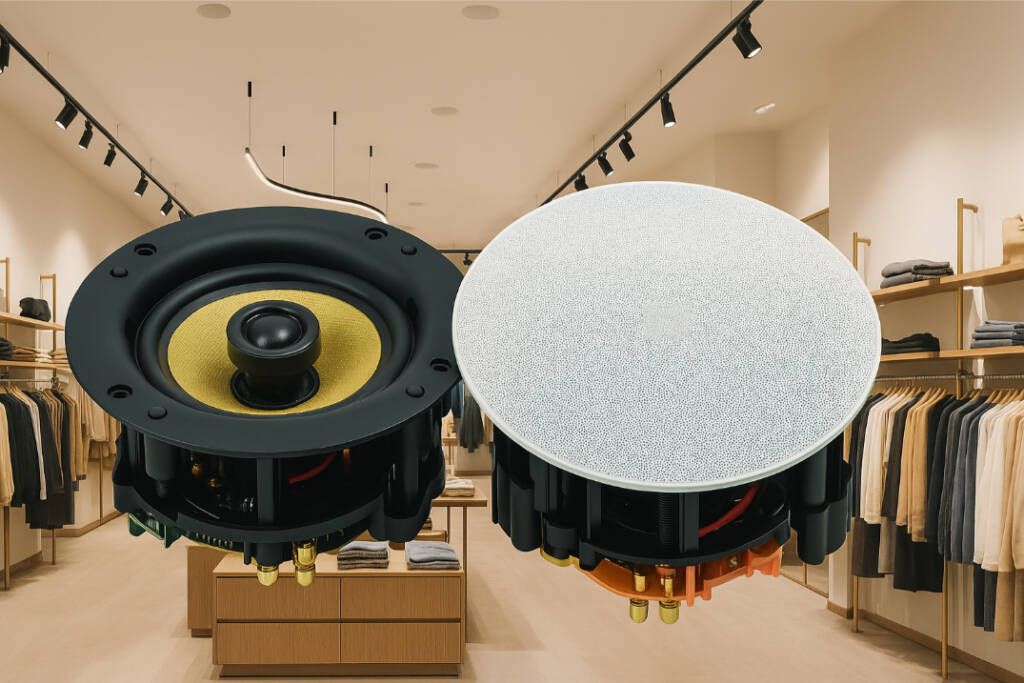
Winston Acoustics covers this with two main options. The Spectre CI 6 is a 6.5-inch two-way speaker rated at 80W, with 89 dB sensitivity, a 61 Hz to 20 kHz range, a pivoting silk-dome tweeter with a 0, -3, and -6 dB switch, and a 100V transformer option for larger floors. The compact Halo 45C is a 4-inch two-way speaker handling 20W, running on 8 ohm or a 100V line with selectable 2.5W and 5W taps, with 88 dB sensitivity and a 90 Hz to 20 kHz range. It suits offices, small shops, low ceilings, and side areas.
How Many Ceiling Speakers Do You Need?
Coverage is about spacing, not a single big speaker. As a rule of thumb, plan for roughly one ceiling speaker per 200 to 250 square feet of floor area for even background sound.
Ceiling height changes the math. A higher ceiling spreads each speaker’s sound wider, so you can space units further apart, though the level at ear height drops. A lower ceiling needs tighter spacing to avoid loud patches directly below each speaker. Aim for gentle overlap between speakers so the sound never drops out between them.
8 Ohm or 100V Line?
This choice decides how your speakers connect. For a few speakers in one room, a standard 8-ohm setup is simple and works well. For many speakers spread across a large space or several zones, use a 100V line system.
On a 100V line, each speaker has a small transformer with selectable power taps, so you set how much power each one draws and balance the whole system easily. As Biamp explains, constant-voltage systems use these transformers to run many speakers over long cable runs with low loss, which is why they are the standard for commercial background music and paging. Both Winston ceiling speakers offer 100V options for exactly this.
Match Commercial Ceiling Speakers to the Space
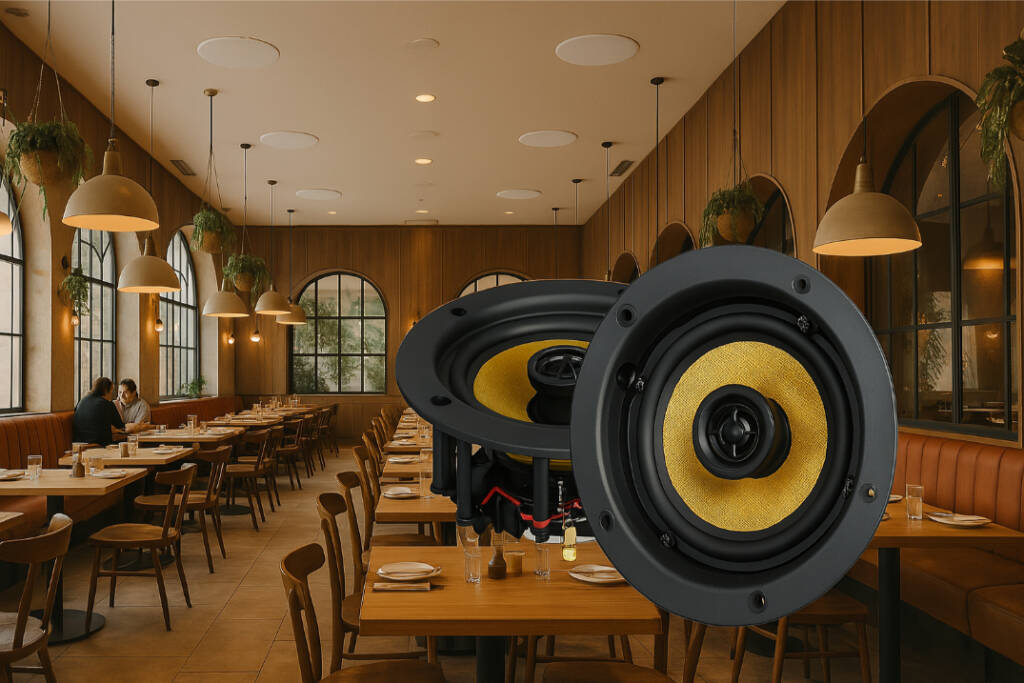
Tune the choice to the room. An office wants low, even sound that supports focus and calls, where a compact speaker like the Halo 45C shines. A café or restaurant wants warm background music across the dining area, suited to the Spectre CI 6. A shop wants even coverage plus clear paging. Reception areas, corridors, and spas want gentle, discreet sound.
For very high or open ceilings, a ceiling speaker may sit too far from listeners, so a pendant speaker is often the better answer. You can plan all of these zones into one background sound system running on a single amplifier.
Installation Tips
Good placement turns good speakers into great sound. Lay out a grid so coverage overlaps evenly, and keep speakers a little in from the room’s edges. Point them away from open microphones to avoid feedback. Use back boxes or fire hoods where building rules require them. Finally, tune by walking the room and listening, then adjust levels until every corner sounds even. For a layout and quote matched to your space, request a quote.
Frequently Asked Questions
How many ceiling speakers do I need?
Plan for roughly one ceiling speaker per 200 to 250 square feet of floor area for even background coverage. A small office or café needs about four to six, while a large open floor needs more. Higher ceilings spread sound wider, so you can space speakers a little further apart.
What is the difference between commercial and home ceiling speakers?
Home and home-theater ceiling speakers chase deep bass, surround, and Atmos effects. Commercial ceiling speakers prioritise even coverage, clear speech and music over long hours, discreet looks, and 100V line wiring for many speakers. For a business, the commercial type is the right choice.
Should I use 8 ohm or 100V ceiling speakers?
Use 8 ohm for a few ceiling speakers in a single room. Use a 100V line system when you run many speakers across a large space or several zones, since it lets you set each speaker’s wattage and run longer cables with less loss. Many Winston ceiling speakers support both.
What size ceiling speaker is best for an office or shop?
A compact 4-inch speaker like the Halo 45C suits offices, small shops, and low ceilings, giving clean, even background sound. For larger floors, a 6.5-inch speaker like the Spectre CI 6 covers more area per unit. Match the size and spacing to the room.
Do ceiling speakers need a special amplifier?
Yes, in most commercial setups. Ceiling speakers need an amplifier sized to the number of speakers and the wiring type. For many speakers on a 100V line, use a commercial amplifier with a matching 100V output; for a few 8-ohm speakers, a standard commercial amplifier works.