The 100V line vs 8 ohm question decides how every speaker in a commercial system connects together. These are the two ways to wire speakers to an amplifier, and they solve very different problems. Pick the wrong one and you get weak sound, dropped speakers, or a fortune wasted on cable. This guide explains how each method works, where 70V and 100V fit in, and when to use which, in plain language.
Two Ways to Wire Speakers
Every speaker system uses one of two wiring methods. Low impedance, usually 8 ohm, is the familiar home and hi-fi approach. The amplifier drives the speakers directly, and you can only connect a few before the amplifier is overloaded.
Constant voltage, known as 100V line or 70V line, is the commercial approach. The amplifier sends a fixed, high voltage down the cable, and each speaker has a small transformer that taps off only the power it needs. This lets many speakers share one amplifier over long distances. The choice between these two shapes the whole install.
How 8-Ohm (Low Impedance) Works
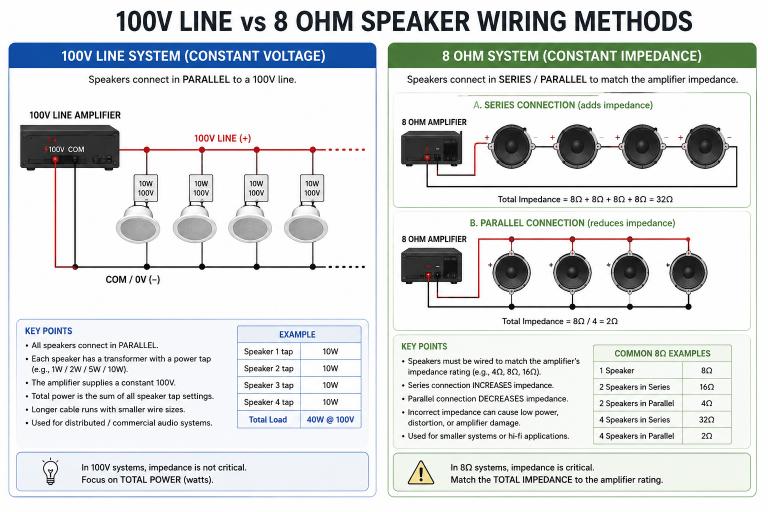
In an 8-ohm system, the speakers connect straight to the amplifier. The amplifier sees the combined impedance of the speakers, measured in ohms. Wire too many speakers in parallel and that impedance drops too low, which overloads the amplifier and can damage it.
In practice, this limits you to a handful of speakers per amplifier, over fairly short cable runs to avoid power loss. The upside is sound quality. For a few speakers in one room playing full-range music, an 8-ohm setup can deliver the cleanest, fullest result.
How 100V Line (Constant Voltage) Works
A 100V line system flips the problem around. The amplifier steps the signal up to a fixed 100 volts, and every speaker carries a step-down transformer with selectable power taps, such as 5W, 10W, 20W, or 40W. You simply set each speaker’s tap, and as long as the total does not exceed the amplifier’s power, the system is balanced. One clarification, since it trips people up: this 100V is the speaker line voltage, not the 230V mains that powers your equipment in India. They are two different things.
Because the line runs at high voltage and low current, almost no signal is lost over long cables, and you can use thinner, cheaper cable. As Biamp explains, this is why constant-voltage systems are the standard for distributing background music and paging across large buildings with many speakers.
Where Does 70V Fit In?
This is the part that confuses people. 70V and 100V are the same constant-voltage system, just at a different line voltage. 100V line is common in India, the UK, and Europe, while 70V is common in the United States for electrical-code reasons. A higher line voltage allows slightly longer cable runs at lower current. Many commercial speakers and amplifiers support both, so the difference rarely causes trouble in practice.
100V Line vs 8 Ohm: Quick Comparison
| Factor | 8 ohm (low impedance) | 100V line (constant voltage) |
|---|---|---|
| Number of speakers | A few per amplifier | Many per amplifier |
| Cable distance | Short runs | Long runs, low loss |
| Wiring | Watch the impedance maths | Add up the wattage taps |
| Cable | Thicker, runs kept short | Thinner cable is fine |
| Best for | One room, full-range music | Multi-zone background music and paging |
Which Should You Choose?
The decision is usually clear once you frame it by scale. Choose 8 ohm for a few speakers in a single room where music quality is the priority, such as a small studio or one office. Choose 100V line when you need many speakers across a large space or several zones, such as a café, shop, hotel, temple, or any multi-room building. Most commercial installs land on 100V line for exactly this reason.
Common Mistakes to Avoid
A few errors come up again and again. Wiring too many 8-ohm speakers in parallel drops the impedance too low and overloads the amplifier. On a 100V line, forgetting that the speaker taps add up can push the total past the amplifier’s rating. Mixing low-impedance speakers onto a 100V line without transformers, or the reverse, simply will not work. And using thin cable on a long 8-ohm run wastes power as heat. Match every speaker and the amplifier output to the same system before you connect anything.
Ready to Choose Your System?
Once you know which method fits your space, pick speakers and an amplifier that support it. Many Winston Acoustics speakers, such as the Spectre CI 6 ceiling speaker and the Jaguar Series wall speaker, offer both 8-ohm and 100V operation, so you are not locked in. You can plan the whole thing as one background sound system, or ask for a layout and quote matched to your space.
Frequently Asked Questions
What are 100V line speakers?
100V line speakers are commercial speakers fitted with a small transformer that connects them to a 100V constant-voltage system. The transformer lets each speaker draw only a set amount of power, so many speakers can share one amplifier and one cable run. They are the standard for background music and paging in shops, offices, and large buildings.
How do 100V line speakers work?
The amplifier raises the audio signal to a fixed 100 volts. Each speaker’s transformer then steps that down and takes only the wattage set by its tap. Because the line runs at high voltage and low current, very little signal is lost over long cables, so you can wire many speakers in a simple daisy chain.
Is 100V line better than 8 ohm?
Neither is better overall; they suit different jobs. 100V line is better for many speakers spread across a large or multi-zone building, since it is easy to wire and loses little over distance. An 8-ohm setup is better for a few speakers in one room, where it can deliver slightly higher fidelity for full-range music.
What cable do I need for 100V line speakers?
100V line runs at low current, so it does not need thick speaker cable. Standard two-core install cable is usually enough, and longer or higher-power runs simply use a slightly larger gauge. Always use the cable rating your installer or amplifier maker recommends, and keep connections tidy and correctly polarised.
Can you mix 100V and 8-ohm speakers?
Not directly on the same line. A 100V line needs speakers with matching transformers, and an 8-ohm output needs low-impedance speakers wired to a safe total impedance. Many speakers support both modes, but you must set each speaker and the amplifier output to the same system before connecting them.