A commercial amplifier is the heart of any installed sound system. It powers every speaker, mixes the music and the microphones, and ties the zones together. Get it right and the whole system sounds clean and runs for years. Get it wrong and you fight distortion, dead zones, and overheating. This guide explains what a commercial amplifier does, how the 100V line system works, and how to choose the right one for your space.
What a Commercial Amplifier Does
A home hi-fi amplifier drives two speakers in one room for a few hours. A commercial amplifier is a different animal. It drives many speakers across several zones, runs all day, and combines microphones with music in one box.
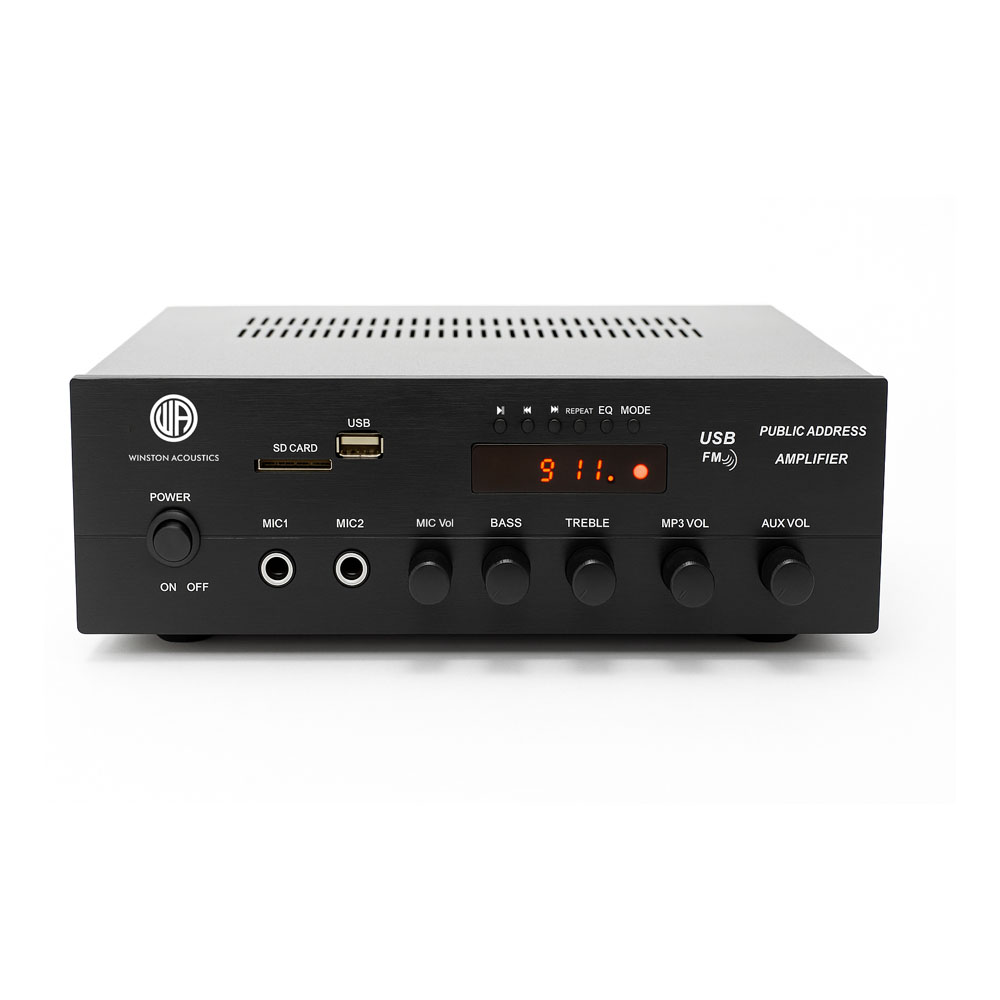
Most commercial units are mixer amplifiers. They take several inputs, such as a music source and a paging microphone, give each its own volume and tone, and then amplify the result to your speakers. That all-in-one design is why a single unit can run background music in a café, announcements at a counter, and a separate level on a terrace, all at once.
100V Line vs 8 Ohm: The Key Choice
This is the decision that shapes the whole system. A standard 8-ohm, low-impedance connection suits a few speakers in one room over short cable runs. Add too many speakers or too much cable, though, and the amplifier struggles.
A 100V line system solves that. Also called constant-voltage, it steps the signal up to a fixed 100V, and each speaker carries a small transformer that draws only the power it needs. As Biamp explains, this lets many speakers share one cable over long distances with very little loss, which is why it is the standard for commercial background music and paging.
You will also see 70V line. It works on exactly the same principle, just at a different line voltage. 100V is common in India, the UK, and Europe, while 70V is common in the United States. A higher line voltage allows even longer runs, and many amplifiers and speakers support both.
Mixer Amplifier Features That Matter
Beyond power, the features decide how useful the amplifier is day to day. Look for microphone inputs with priority, so announcements automatically lower the music. Look for multiple zones if different areas need different levels or sources. Modern sources like Bluetooth, USB, and FM make it easy to feed music in. A REC or link output lets you daisy-chain amplifiers as the system grows.
Winston Acoustics covers both ends of this range. The RC 40 is a compact 40W amplifier with two microphone inputs, AUX, USB, Bluetooth, and FM, a 100V or 4 to 16-ohm output, and a REC out for daisy-chaining. It suits small offices and cafés. For larger, multi-zone sites, the MX 240 delivers 240W across two zones, with Bluetooth, USB, line, and microphone inputs, microphone priority, and the ability to stack for bigger systems.
How to Size a Commercial Amplifier
Sizing is simple arithmetic with a safety margin. Add up the power your speakers will draw. On a 100V line, total the wattage tap set on each speaker. Then add 20 to 30 percent headroom, so the amplifier never runs flat out and stays cool.
Match the output type to your speakers too. Do not hang a long 100V chain off an amplifier that only offers 8-ohm outputs, and do not overload a low-impedance output with too many speakers. Finally, count the zones you need, because that decides whether a single-zone or multi-zone amplifier is right.
Matching the Amplifier to Your Speakers and Zones
The amplifier and the speakers are one system, so plan them together. Ceiling, wall, and outdoor speakers can all run from one 100V amplifier, each on its own zone at its own level. You can build the whole thing as a single background sound system rather than juggling separate setups, and expand it later by stacking amplifiers.
What a Commercial Amplifier Costs
Cost depends on power, the number of zones, and features like Bluetooth and microphone priority. As a rough market guide in India, a compact single-zone amplifier sits at the lower end, while a multi-zone 240W unit costs more. For a system matched to your speakers and zones, request a quote.
Frequently Asked Questions
What is a 100V line amplifier?
A 100V line amplifier, also called a constant-voltage amplifier, steps the audio signal up to a fixed 100V so it can travel long distances with little loss. Each speaker has a small transformer that takes only the power it needs. This lets many speakers run from one amplifier on a single cable, which is why it is the standard for commercial sound.
What is the difference between 70V and 100V line?
They work the same way; only the line voltage differs. 100V line is common in India, the UK, and Europe, while 70V is common in the United States. A higher line voltage allows even longer cable runs with low loss. Many commercial amplifiers and speakers support both.
What is the difference between a mixer amplifier and a power amplifier?
A power amplifier only boosts an incoming signal to drive speakers. A mixer amplifier combines several inputs first, such as microphones and music sources, with volume and tone control, and then amplifies them. For most commercial installs, a mixer amplifier is the simpler all-in-one choice.
What amplifier do I need for ceiling speakers?
Choose an amplifier that matches how the ceiling speakers are wired. For a few 8-ohm speakers in one room, a small commercial amplifier works. For many ceiling speakers across zones, use a 100V line amplifier with enough power for the total load plus headroom.
How do I choose the right commercial amplifier size?
Add up the power your speakers will draw, then add 20 to 30 percent headroom so the amplifier never runs flat out. On a 100V line, total the wattage tap of each speaker. Also count how many independent zones you need, since that decides whether you need a multi-zone amplifier.