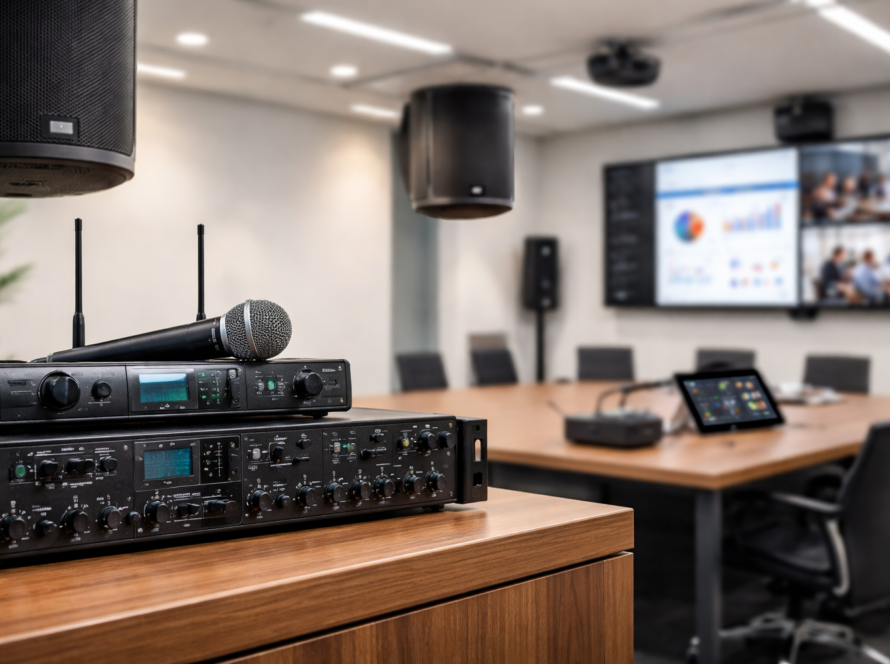
Good church sound system setup is less about expensive gear and more about method. A clear sermon in a tall, echoey church comes from careful placement, gain, and tuning, not from sheer volume. This guide is for church committees and volunteer sound teams who want speech everyone can follow and worship music that still sounds warm. It complements the Winston Acoustics church sound systems range by focusing on how to set the system up and tune it well.
Church Sound System Setup Starts With Zones
Plan the zones before you mount a single speaker. Sketch the building and mark each area: the sanctuary and pulpit, the nave and pews, the choir or worship band, the narthex, any fellowship hall or cry room, and the forecourt.
Each zone needs its own level. The sanctuary carries speech, the band zone carries music, and the hall just needs a gentle relay. A multi-zone amplifier such as the Winston MX 240 handles this, mixing pulpit, lectern, and choir microphones with music and running each zone at its own volume. Map this first, because it drives every choice that follows.
Speaker Placement for a Clear Church Sound System
Placement decides clarity. Aim speakers at the congregation, not at the walls. Controlled-dispersion speakers do this by design, putting energy on the pews instead of the hard surfaces that cause echo.
Match the speaker to the space. Compact ceiling speakers like the Halo 45C suit low ceilings, side aisles, and chapels, while the larger Spectre CI 6 covers open naves. Directional wall speakers like the Jaguar Series project down a tall nave. Compact surface speakers like the Neptune Series fit balconies and Sunday-school rooms. For the forecourt and outdoor services, the weatherproof Mirage 100W runs as one more zone.
One rule saves endless trouble: keep speakers in front of the microphones, never behind them. That single habit prevents most feedback.
Microphone Setup and Feedback Control
Clear preaching depends on the microphone as much as the speaker. Give the preacher a lapel or headset mic, add a podium mic for readings, and add choir mics where needed.
Set each mic’s gain just below the point where it starts to ring. If a frequency howls, lower it on the mixer’s equaliser rather than turning everything down. Give speech priority over music, so the sermon always cuts through the worship bed. Keep open mics away from the speakers, and the system stays stable all service.
Tame the Echo in a Reverberant Church
Echo is the enemy of clarity. Stone, plaster, and high ceilings reflect sound into a long tail that smears words together. As acoustics specialists note, too much reverberation harms speech intelligibility.
Three moves help. Lower the overall volume, because louder sound only feeds the echo. Aim speakers down at the pews so less energy hits the walls. Add soft furnishings or acoustic panels where the building allows. Together these turn a boomy room into a clear one.
Add Delay Speakers for Long Naves
A long nave creates a timing problem. Sound from the front speakers reaches the back pews a moment late, which blurs speech over distance.
The fix is delay speakers. Place extra speakers partway down the nave or under a balcony, then time them to fire just after the sound from the front arrives. The back rows then hear the words in sync with the front, and clarity holds the full length of the church.
Balance the Zones, Then Walk the Room
With speakers and mics set, balance the levels. Set each zone in turn, then walk the whole building during a service or rehearsal. Listen in every pew, aisle, hall, and at the forecourt.
Adjust until coverage feels even, with no dead spots and no painfully loud seats. This walking test catches problems that look fine on paper. Tune by what you hear, not by the meters alone.
A Church Sound System Setup Volunteers Can Run
The best church system is one a volunteer can operate on a quiet Sunday. Keep the source simple, with clear microphone and music inputs. Label every zone. Lock sensible levels so the desk is close to set-and-forget.
This is where professional planning pays off. Winston Acoustics designs the layout, plans the zones, and calibrates the system, leaving volunteers to manage only day-to-day levels. For a system matched to your building, request a quote.
Frequently Asked Questions
How do I stop feedback in a church sound system?
Feedback happens when a microphone picks up sound from the speakers and loops it. Place speakers in front of the microphones, never behind them, and set each mic’s gain just below the point where it rings. Use the mixer’s equaliser to lower the exact frequencies that howl.
Do I need delay speakers in a long church?
Often, yes. In a long nave, sound from the front speakers reaches the back pews late, which blurs speech. Adding speakers partway down the nave, timed to fire just after the front sound arrives, keeps the words in sync and clear for the back rows.
How do I set up microphones for clear sermons?
Use a dedicated microphone for the preacher, such as a lapel or headset mic, plus a podium mic for readings. Keep mics close to the speaker’s mouth, set gain just below feedback, and give speech priority over music in the mixer so the sermon always cuts through.
Why does my church echo, and how do I reduce it?
Hard stone, plaster, and high ceilings reflect sound into a long echo that smears speech. Lower the overall volume, since louder sound makes the echo worse, and aim speakers down at the congregation rather than the walls. Soft furnishings and acoustic panels help where they can be added.
Can volunteers operate a church sound system?
Yes, with a simple setup. Use a multi-zone amplifier with clear microphone and music inputs, label every zone, and lock sensible levels so the system is close to set-and-forget. Winston Acoustics can plan the layout and calibrate it so volunteers only manage day-to-day levels.