A good restaurant sound system shapes how long guests linger, how relaxed they feel, and how your food and service come across. Choosing one comes down to three decisions: the hardware that fills the room evenly, the music source that feeds it, and the licence that keeps it legal in India. This guide covers all three, and shows you how to design and tune the system zone by zone.
Here is the short version before the detail:
- Hardware — speakers and an amplifier sized to your floor area and zones.
- Source — a player or service that is licensed for commercial use.
- Licence — the public-performance permissions Indian law requires.
Why a Restaurant Needs Distributed Audio, Not a Stereo
A home hi-fi or surround system aims sound at one sofa. A restaurant has no single listening spot. Guests sit everywhere, so you need even coverage across the whole room.
That is the core idea behind any good restaurant sound system. Instead of one or two powerful point sources, you use several smaller speakers spread across the ceiling or walls. Each covers a small area at a modest volume, and together they create a smooth, consistent wash of background music. No table gets blasted, and no table strains to listen. This approach also keeps music under conversation, where it belongs. Loud is rarely the goal; even and natural is.
Choose the Right System for Your Restaurant’s Size
Before the zone-by-zone detail, start with scale. The system you need depends on your floor area and how many zones you run.
Small café or restaurant (up to about 50 m², one zone). A handful of compact ceiling speakers such as the Halo 45C, driven by a small amplifier with Bluetooth like the RC 40, covers most small venues with even background music and nothing to fiddle with during service.
Mid-size restaurant (about 50–150 m², one to two zones). A larger floor needs more speakers and usually a second zone, so the dining room and the bar can sit at different levels. Add ceiling and wall speakers, and choose a two-zone amplifier like the MX 240 if you want independent control.
Large or multi-zone restaurant (150 m² and up). Bigger venues run several zones — dining, bar, patio, private rooms — each at its own level, handled cleanly by a multi-zone amplifier on a 100V line.
Rooftops and patios. Terraces and open courtyards face heavy monsoon and humidity, so those zones need weatherproof, IP65-rated outdoor speakers, planned as their own zone.
Bars and high-energy evenings. If evenings get loud, the bar zone may need higher-output speakers like the Ares rather than gentle background units; our bar sound system guide covers this. A full nightclub or dancefloor system is a separate, custom job.
Map Your Zones
Before you pick a single speaker, map your venue. Most restaurants break into clear zones, and each has its own needs.
The main dining room wants smooth, low-level background music. The bar or lounge can run louder and livelier. Reception and waiting areas need a gentle welcome. Restrooms and corridors need only a light fill. The patio or terrace needs weatherproof speakers built for outdoor use. Group these areas on a simple floor plan, then decide where you want independent volume control. A multi-zone setup lets you keep the dining room calm while the bar lifts the energy, all from one system. This zoning step drives every other decision that follows.
Choosing Speakers for Each Zone
Match the speaker type to the zone and the ceiling, not the other way around. Winston Acoustics offers four main options for hospitality spaces, which you can browse in the speakers for restaurant range.
Ceiling speakers suit indoor dining areas that need discreet, even coverage with no visible boxes. The Spectre CI 6 fits this role, with an 8-ohm design, 89 dB sensitivity, a 61 Hz to 20 kHz range, and a pivoting silk-dome tweeter with a 0, -3, and -6 dB level switch for fine-tuning each room.
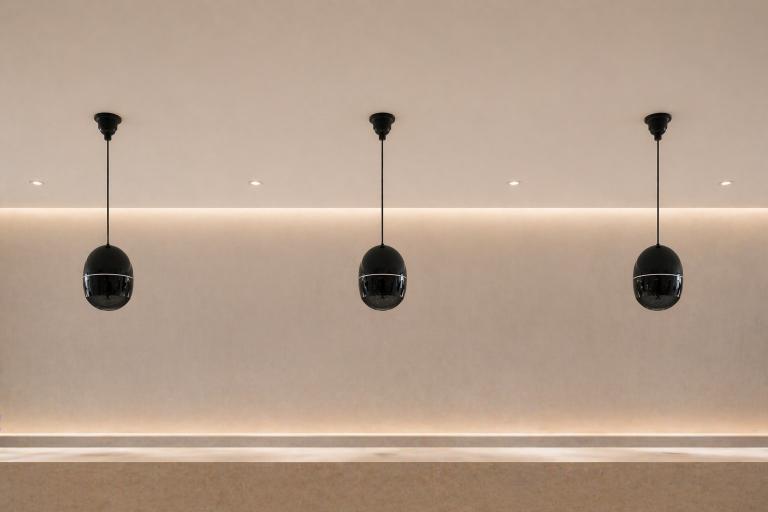
Wall-mounted speakers work where you cannot run cabling above a ceiling, or where you want directional sound aimed into a space. Pendant speakers hang from high or exposed industrial ceilings, common in modern cafés and warehouse-style venues. Outdoor speakers carry a weatherproof rating for terraces, rooftops, and patio dining.
For all-day background music, a compact full-range model like the Poseidon also works well. It pairs a 5-inch driver with 50W RMS and 100W peak power, and reaches 93 dB sensitivity, which keeps light music clean over long service hours.
How Many Speakers Do You Need?
Coverage comes down to spacing. As a rule of thumb, plan for roughly one speaker per 200 to 250 square feet of floor area. A 1,500 square foot dining room usually needs six to eight ceiling speakers for an even spread.
Ceiling height changes this math. Higher ceilings throw sound wider, so you can space speakers further apart. Lower ceilings need tighter spacing to avoid hot spots directly below each unit. Walk the plan in your head, and aim for overlap so the sound never drops out between speakers.
Amplifier, Source and Wiring
The amplifier ties the system into zones. For a small single area, a low-impedance 8-ohm setup is simple and effective. For a larger venue with many speakers over long cable runs, a 70V or 100V line system is the better choice, because it lets you chain many speakers on one cable and set each speaker’s volume tap.
For the music itself, most restaurants use a streaming player, a media source, or a mixer. If you make announcements or host live sets, choose an amplifier with a microphone input that lowers the music automatically while someone speaks.
Wired or wireless? For a venue that plays music all day, a wired distributed system on a 100V line is the reliable choice, because it does not depend on a busy restaurant Wi-Fi network shared by the till, card machines, and staff tablets. The practical middle path is to keep streaming convenience by feeding music into the amplifier over Bluetooth, which the RC 40 supports directly. A well-planned background sound system handles both jobs through the same speakers.
Set Levels for Comfort
Once installed, calibrate by ear. Play music and walk every zone, listening for loud patches near speakers and dead spots between them, then adjust until the coverage feels even. Aim for a level where guests talk comfortably without raising their voices.
Keep volume sensible for staff too, since they work full shifts in the room. The World Health Organization recommends a maximum average of 100 dB for venues and events, and a dining room should sit well below that.
The Music Source: Why Personal Spotify Is Not Legal in a Venue
With the hardware sorted, you need something to play. A personal music subscription is not legal for a business. Consumer services like Spotify, Apple Music, and YouTube Music are licensed for personal listening only, and their own terms do not cover public playback in a commercial space, even on a paid premium account.
For a venue, use a music service intended for commercial use, or another properly licensed source, and feed it into your amplifier over Bluetooth, a cable, or a small dedicated player. Two things matter more than the brand of service: that it is licensed for business use, and that it meets India’s public-performance rules, which is the final decision below.
Music Licensing for Restaurants in India
Under the Copyright Act, 1957, playing recorded music publicly in a commercial venue generally requires permission, and a single song involves two separate rights: the sound recording, and the underlying musical and literary work. As the Indian Performing Right Society explains, a separate licence is needed for each.
Those rights are administered by different bodies. IPRS represents the musical and literary works — composers, lyricists, and publishers. Sound recordings are handled by private entities such as PPL (Phonographic Performance Limited), Novex Communications, and RMPL, with Novex covering specific film repertoire from labels like Zee, YRF, and Shemaroo.
This area is also genuinely disputed in India. PPL and IPRS are not currently registered as copyright societies under Section 33 of the Act, and grant licences under Section 30 as rights owners, and restaurant bodies such as the NRAI have challenged some collection practices in court. So the licences you actually need depend on the specific music you play and on current law. Confirm the requirements for your venue directly with the relevant bodies, and ideally a legal advisor, before you open. A commercial music service may simplify the source side, but it does not automatically settle your Indian public-performance dues. This is general information, not legal advice.
Restaurant Sound System Mistakes to Avoid
A few errors show up again and again. Fitting too few speakers leaves cold spots and forces the volume up. Running the whole venue as one zone means the bar and the quiet corner share the same level. Using consumer Bluetooth speakers for all-day service leads to overheating and distortion. Skipping weatherproof speakers on the patio shortens their life in the first monsoon.
Avoid these, and your system will sound natural for years. For a layout matched to your venue, request a site-specific quote.
Frequently Asked Questions
What does a restaurant sound system include?
Most restaurants need a distributed system: several ceiling or wall speakers spread for even, low-level sound, run from one commercial amplifier on a 100V line, with a player or streaming source for the music. Small venues need one zone, while larger or multi-area venues need a multi-zone amplifier so the dining room, bar, and patio can each play at their own level.
How much does a restaurant sound system cost in India?
Cost depends on the venue size, the number of zones, and the speaker count. As a rough market guide, small cafés and restaurants can start around ₹40,000 to ₹80,000, while large multi-zone fit-outs run well beyond ₹3,00,000. Request a quote for an exact figure.
How many speakers does a restaurant need?
Plan for roughly one speaker per 200 to 250 square feet of floor area. A 1,500 square foot dining room usually needs six to eight ceiling speakers. Higher ceilings let you space speakers further apart.
Can one system play different music in the bar and dining area?
Yes. A multi-zone amplifier or matrix lets you set different volumes, and often different music, in the bar, dining room, and patio from a single system.
Can I play Spotify in my restaurant?
Not on a personal subscription. Consumer services like Spotify, Apple Music, and YouTube Music are licensed for personal listening, and their terms do not cover public playback in a business. For a venue you need a music source intended for commercial use, and you still need to meet India’s public-performance licensing requirements separately.
Do I need a licence to play music in my restaurant in India?
Generally, yes. Playing recorded music publicly in a commercial venue uses two separate rights, the sound recording and the underlying composition, which are administered by different bodies such as PPL, Novex, and IPRS. This area is also actively disputed in India, so the licences you actually need depend on the music you play and current law. Confirm the requirements for your venue with the relevant bodies, and ideally a legal advisor, before you open. This is general information, not legal advice.
Should a restaurant sound system be wired or wireless?
For a venue that runs music all day, a wired distributed system on a 100V line is the reliable standard, because it does not depend on a busy restaurant Wi-Fi network. You can still keep streaming convenience by feeding music into the amplifier over Bluetooth or a cable. Fully wireless speakers suit very small spaces but can struggle in a busy venue.
Good restaurant sound system design shapes how long guests linger, how relaxed they feel, and how your food and service come across. Yet most venues get it wrong in the same way. They treat audio like a home setup, plug in a big stereo or a couple of loud speakers, and end up with blasting tables near the source and silence in the corners. This guide shows you how to plan even, comfortable sound that fits your space, zone by zone.
Why a Restaurant Needs Distributed Audio, Not a Stereo
A home hi-fi or surround system aims sound at one sofa. A restaurant has no single listening spot. Guests sit everywhere, so you need even coverage across the whole room.
That is the core idea behind restaurant sound system design. Instead of one or two powerful point sources, you use several smaller speakers spread across the ceiling or walls. Each one covers a small area at a modest volume. Together they create a smooth, consistent wash of background music. No table gets blasted. No table strains to listen.
This approach also keeps music under conversation, where it belongs. Diners should chat easily while still feeling the atmosphere. Loud is rarely the goal. Even and natural is.
Start With Zones: Restaurant Sound System Design by Area
Before you pick a single speaker, map your venue. Most restaurants break into clear zones, and each one has its own needs.
The main dining room wants smooth, low-level background music. The bar or lounge can run louder and livelier. Reception and waiting areas need a gentle welcome. Restrooms and corridors need only a light fill. The patio or terrace needs weatherproof speakers built for outdoor use.
Group these areas on a simple floor plan. Then decide where you want independent volume control. A multi-zone setup lets you keep the dining room calm while the bar lifts the energy, all from one system. This zoning step drives every other decision that follows.
Choosing Speakers for Each Zone
Match the speaker type to the zone and the ceiling, not the other way around. Winston Acoustics offers four main options for hospitality spaces, which you can browse in the speakers for restaurant range.
Ceiling speakers suit indoor dining areas that need discreet, even coverage with no visible boxes. The Spectre CI 6 fits this role, with an 8-ohm design, 89 dB sensitivity, a 61 Hz to 20 kHz range, and a pivoting silk-dome tweeter with a 0, -3, and -6 dB level switch for fine-tuning each room.
Wall-mounted speakers work where you cannot run cabling above a ceiling, or where you want directional sound aimed into a space. Pendant speakers hang from high or exposed industrial ceilings, common in modern cafés and warehouse-style venues. Outdoor speakers carry a weatherproof rating for terraces, rooftops, and patio dining.
For all-day background music, a compact full-range model like the Poseidon also works well. It pairs a 5-inch driver with 50W RMS and 100W peak power, and reaches 93 dB sensitivity, which keeps light music clean over long service hours.
How Many Speakers Do You Need?
Coverage comes down to spacing. As a rule of thumb, plan for roughly one speaker per 200 to 250 square feet of floor area. A 1,500 square foot dining room usually needs six to eight ceiling speakers for an even spread.
Ceiling height changes this math. Higher ceilings throw sound wider, so you can space speakers further apart. Lower ceilings need tighter spacing to avoid hot spots directly below each unit. Walk the plan in your head, and aim for overlap so the sound never drops out between speakers.
Amplifier and Source: Wiring It Together
The amplifier ties the system into zones. For a small single area, a low-impedance 8-ohm setup is simple and effective. For a larger venue with many speakers over long cable runs, a 70V or 100V line system is the better choice. Line systems let you chain many speakers on one cable and set each speaker’s volume tap.
For the music itself, most restaurants use a streaming player, a media source, or a mixer. If you make announcements or host live sets, choose a mixer or amplifier with a microphone input that lowers the music automatically while someone speaks. A well-planned background sound system handles both jobs through the same speakers.
Setting Levels and Staying Legal
Once installed, calibrate by ear. Play music and walk every zone. Listen for loud patches near speakers and dead spots between them, then adjust until the coverage feels even. Aim for a level where guests talk comfortably without raising their voices.
Keep volume sensible for staff too. They work full shifts in the room. The World Health Organization recommends a maximum average of 100 dB for venues and events, and a dining room should sit well below that.
One more practical point. In India, playing recorded music in a commercial venue generally requires a public-performance licence, usually through bodies such as PPL and IPRS. Rules and fees change over time, so confirm the current requirements before you go live. This is general information, not legal advice.
Restaurant Sound System Design Mistakes to Avoid
A few errors show up again and again. Fitting too few speakers leaves cold spots and forces the volume up. Running the whole venue as one zone means the bar and the quiet corner share the same level. Using consumer Bluetooth speakers for all-day service leads to overheating and distortion. Skipping weatherproof speakers on the patio shortens their life in the first monsoon.
Avoid these, and your system will sound natural for years. For a layout matched to your venue, request a site-specific quote.
Frequently Asked Questions
How much does a restaurant sound system cost in India?
Cost depends on the venue size, the number of zones, and the speaker count. As a rough market guide, small cafés and restaurants can start around ₹40,000 to ₹80,000, while large multi-zone fit-outs run well beyond ₹3,00,000. Request a quote for an exact figure.
What speakers are best for a restaurant?
It depends on the space. Ceiling speakers such as the Spectre CI 6 suit indoor dining, weatherproof speakers handle patios and terraces, and wall or pendant speakers work where ceilings cannot be used. Most restaurants combine a few types across zones.
How many speakers does a restaurant need?
Plan for roughly one speaker per 200 to 250 square feet of floor area. A 1,500 square foot dining room usually needs six to eight ceiling speakers. Higher ceilings let you space speakers further apart.
Can one system play different music in the bar and dining area?
Yes. A multi-zone amplifier or matrix lets you set different volumes, and often different music, in the bar, dining room, and patio from a single system.
Do I need a licence to play music in my restaurant in India?
In most cases, yes. Indian copyright law generally requires a public-performance licence to play recorded music in a commercial venue, typically through bodies such as PPL and IPRS. Rules and fees change, so confirm current requirements before you go live. This is general information, not legal advice.